House Rules For Children
House Rules for a Muslim Home
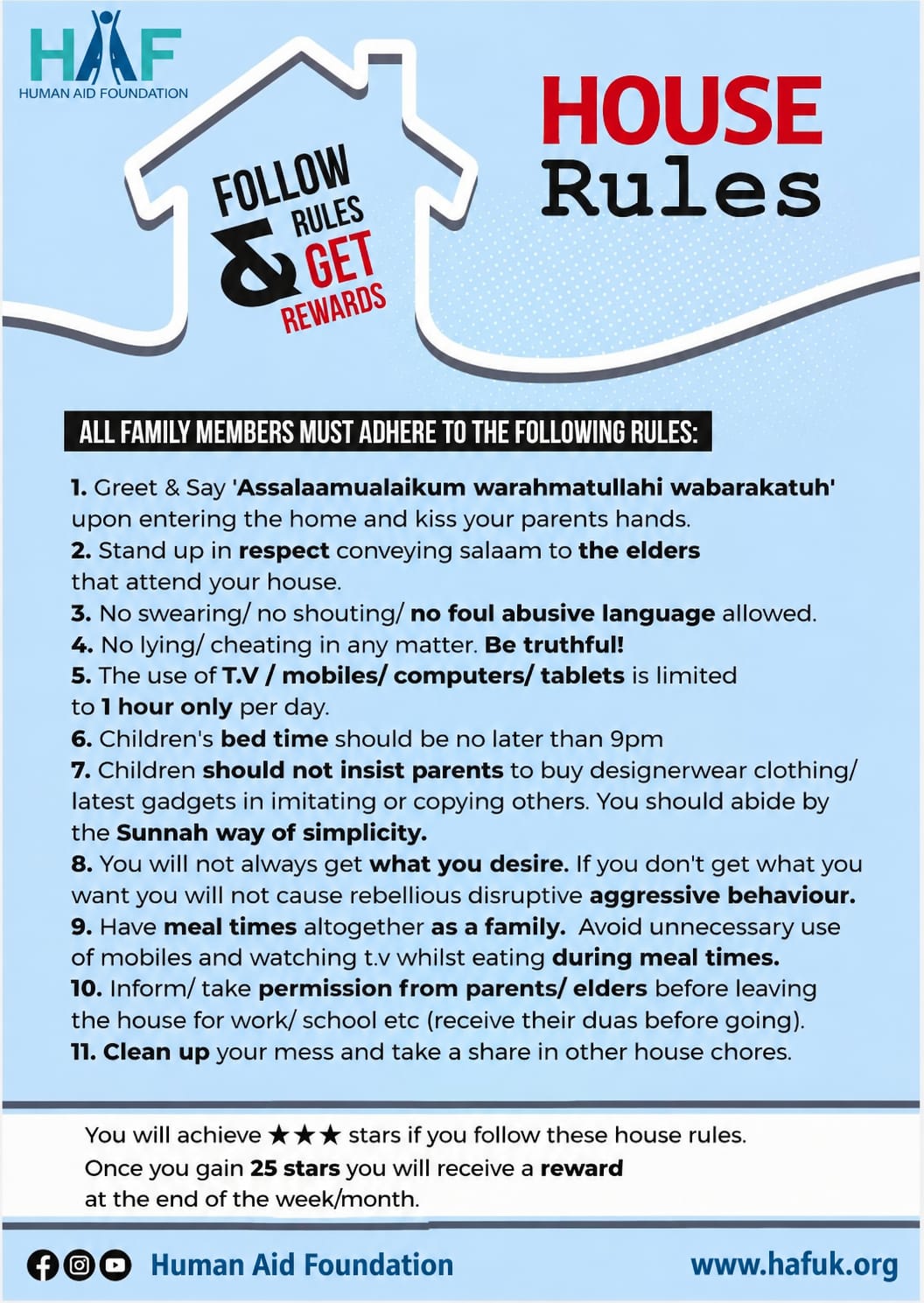
Why put house rules on the wall?
A rule that is only said out loud is easy to forget. When the rules hang in the hallway or the kitchen, children read them as they come and go, at mealtimes and on their way to school. After a few weeks they know exactly what is expected of them at home.
It also makes parenting easier. If a child breaks a rule, you can point to the poster and calmly ask, "You broke this rule. Why?" The conversation is then about a rule the whole family can see, and the child knows it applies to everyone. When a child keeps the rules, you have a clear reason to praise and reward them.
When everyone at home lives by the same rules, there is less arguing and more respect between parents and children. Our hope is that every home which puts these rules up becomes calmer and happier, a home that brings us closer to the peace of Jannah.
The 11 house rules
All family members must follow these rules.
1. Greet and say "Assalaamualaikum warahmatullahi wabarakatuh" when you enter the home, and kiss your parents' hands
Salaam is the first thing children say at the door, and kissing their parents' hands teaches them to honour their mother and father.
2. Stand up in respect and give salaam to the elders who visit your house.
Guests notice how children receive them. Standing up to greet an elder is a small habit that
shows good upbringing.
The Prophet ﷺ said that whoever gives a fasting person something to break their fast with receives a reward like theirs, without the fasting person's own reward being reduced in the slightest (reported in Jami' at-Tirmidhi).
3. No swearing, no shouting and no foul or abusive language
4. No lying or cheating in any matter. Be truthful!
Small lies easily turn into habits. Praise your child when they tell the truth, especially when the
truth was hard to say.
5. TV, mobiles, computers and tablets are limited to 1 hour a day
Agree with your children which hour of the day is screen time, so you are not negotiating it every
evening.
6. Children's bedtime should be no later than 9pm.
A fixed bedtime means children wake up rested and ready for school.
7. Children should not pressure their parents to buy designer clothes or the latest gadgets just to
copy others. Follow the Sunnah way of simplicity.
This teaches children to be content with what they have, whatever their friends are wearing or
using.
8. You will not always get what you want. If you don't get it, you will not become rebellious,
disruptive or aggressive.
Children learn patience when a "no" is said kindly and stays a "no".
9. Eat meals together as a family. Avoid using mobiles or watching TV during mealtimes.
For many families, dinner is the only time everyone sits down together. With the phones put
away, people actually talk.
10. Tell your parents or elders, and take their permission, before leaving the house for work, school
or anything else. Receive their duas before you go.
Parents always know where their children are, and children leave home with their parents' duas.
11. Clean up your own mess and do your share of the house chores.
Helping at home teaches responsibility and shows children they have a real part in running the
family home.
How the star reward works
Children earn three stars when they follow the house rules. Once a child has collected 25 stars, they
receive a reward at the end of the week or month.
Keep a simple star chart next to the poster so children can see their progress. It helps to agree on the
reward together in advance. A trip to the park, a favourite meal or an extra story at bedtime works just
as well as a toy.
How to use the poster at home
1. Print the PDF on A4 paper, in colour if you can.
2. Put it up at your children's eye level, somewhere everyone passes every day, such as the hallway,
the kitchen or by the front door.
3. In the first week, read the rules together and explain what each one means.
4. Follow the rules yourself. The poster says "all family members", and children notice quickly when
parents don't.
5. Stay consistent. Give stars as soon as they are earned, and deal with broken rules calmly each
time.
Share the House Rules
The poster is free for every family to use. If it helps in your home, please share this page with friends
and relatives, or with parents at your mosque or your children's school.
2. Stand up in respect and give salaam to the elders who visit your house.
Guests notice how children receive them. Standing up to greet an elder is a small habit that shows good upbringing.
The Prophet ﷺ said that whoever gives a fasting person something to break their fast with receives a reward like theirs, without the fasting person's own reward being reduced in the slightest (reported in Jami' at-Tirmidhi).
3. No swearing, no shouting and no foul or abusive language
4. No lying or cheating in any matter. Be truthful!
Small lies easily turn into habits. Praise your child when they tell the truth, especially when the truth was hard to say.
5. TV, mobiles, computers and tablets are limited to 1 hour a day
Agree with your children which hour of the day is screen time, so you are not negotiating it every evening.
6. Children's bedtime should be no later than 9pm.
A fixed bedtime means children wake up rested and ready for school.
7. Children should not pressure their parents to buy designer clothes or the latest gadgets just to copy others. Follow the Sunnah way of simplicity.
This teaches children to be content with what they have, whatever their friends are wearing or using.
8. You will not always get what you want. If you don't get it, you will not become rebellious, disruptive or aggressive.
Children learn patience when a "no" is said kindly and stays a "no".
9. Eat meals together as a family. Avoid using mobiles or watching TV during mealtimes.
For many families, dinner is the only time everyone sits down together. With the phones put away, people actually talk.
10. Tell your parents or elders, and take their permission, before leaving the house for work, school or anything else. Receive their duas before you go.
Parents always know where their children are, and children leave home with their parents' duas.
11. Clean up your own mess and do your share of the house chores.
Helping at home teaches responsibility and shows children they have a real part in running the family home.
Children earn three stars when they follow the house rules. Once a child has collected 25 stars, they receive a reward at the end of the week or month.
Keep a simple star chart next to the poster so children can see their progress. It helps to agree on the reward together in advance. A trip to the park, a favourite meal or an extra story at bedtime works just as well as a toy.
1. Print the PDF on A4 paper, in colour if you can.
2. Put it up at your children's eye level, somewhere everyone passes every day, such as the hallway, the kitchen or by the front door.
3. In the first week, read the rules together and explain what each one means.
4. Follow the rules yourself. The poster says "all family members", and children notice quickly when parents don't. 5. Stay consistent. Give stars as soon as they are earned, and deal with broken rules calmly each time.
The poster is free for every family to use. If it helps in your home, please share this page with friends and relatives, or with parents at your mosque or your children's school.