I'tikaf
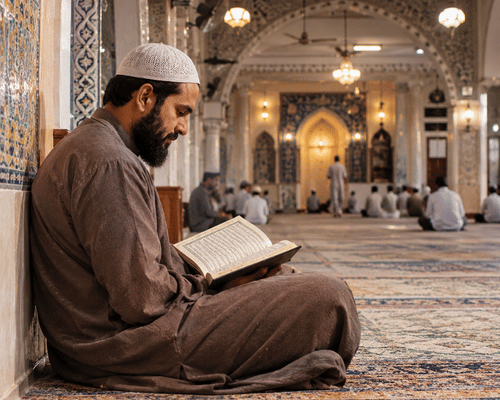
I'tikaf is a retreat in the mosque, usually for the last ten days of Ramadan. The word means staying put - devoting yourself to one place. The Prophet ﷺ kept it every year until he died, and his wives kept it after him.
The nights it is kept for are covered on the Laylatul Qadr page.
What the Word Means
The root behind i'tikaf means to stay somewhere, to remain, to keep at something persistently.
It is not a word reserved for worship. The Qur'an uses the same root for people who stayed devoted to idols - Ibrahim asks his people about the statues they are devoted to (Qur'an 21:52). The word describes the attaching, not what you attach yourself to.
So i'tikaf is attaching yourself to the mosque, for a fixed period, deliberately.
Where It Comes From
The Qur'an mentions it inside the fasting verses, in passing and without introduction - a sign that it was already familiar. It instructs that marital relations are not to take place while in retreat in the mosques (Qur'an 2:187).
Aisha reported that the Prophet Muhammad ﷺ kept i'tikaf in the last ten days of Ramadan until Allah took him, and that his wives kept it after him (Sahih al-Bukhari 2026; Sahih Muslim 1172).
He had not always done the last ten. Abu Sa'id al-Khudri described him keeping the middle ten, and then telling those who had been with him to continue into the last ten, because he had been shown the Night of Decree and then caused to forget which night it was (Sahih al-Bukhari 2027).
In the year he died, he kept twenty days.
It Is Not Total Isolation
People imagine something more severe than it is.
Aisha said that the Prophet ﷺ would put his head out of the mosque towards her room, and she would comb and oil his hair - and that she did this during her monthly period, when she could not enter the mosque herself (Sahih al-Bukhari 2028).
Going in on a later night and seeing the people praying together behind their reciter, he said: what an excellent innovation this is (Sahih al-Bukhari 2010).
A man in retreat, leaning his head out of a doorway so his wife can do his hair. That is in the collection, under its own chapter heading.
So: sleeping, eating, washing, reading, talking quietly with someone who visits - all of it is ordinary and none of it breaks anything. What is set aside is leaving without need, and marital relations.
The Year He Abandoned It
One narration is worth knowing because of what it says about motive.
The Prophet ﷺ intended i'tikaf one Ramadan, and a tent was pitched for him in the mosque. One of his wives asked for a tent to be pitched for her as well. Then another. Then another.
He came out in the morning and saw the row of tents - and he had them taken down, and did not keep i'tikaf that Ramadan at all, making it up in Shawwal instead (reported in Sahih Muslim).
A retreat that had turned into a gathering was no longer the thing he had set out to do. He stopped rather than continue it in that form.
What It Requires
A mosque. The schools differ on which kind. Hanafi scholars require a mosque where the five daily prayers are held in congregation; others are stricter or more lenient.
An intention. Formed before entering, and held for the period you have decided on.
Fasting, for the sunnah i'tikaf of Ramadan, which is why the two go together. Scholars differ over whether a voluntary i'tikaf outside Ramadan requires it.
Staying. Leaving for genuine need - the toilet, ablution, the Friday prayer where the mosque does not hold it, food where nobody brings it, a medical emergency - is permitted and does not break it. Leaving without need does.
The sunnah i'tikaf of Ramadan runs from before sunset on the twentieth to the sighting of the Shawwal moon. Al-Shafi'i advised entering the mosque before sunset on the twenty-first night for anyone wanting to follow the practice.
What It Requires
Here is the part that matters for most people reading this, and it is more reassuring than expected.
I'tikaf in the last ten days is a communal sunnah. If some people in a locality keep it, the obligation is considered met and nobody else is blamed for not doing so. One person in the mosque relieves the street.
That is worth knowing before you feel bad about work, childcare, or a tenancy that does not allow for ten nights away. Many British mosques run organised i'tikaf and the same mosques have congregations who do not join it. Neither group is failing.
Shorter retreats are also available. A voluntary i'tikaf carries no minimum in several views - entering a mosque with the intention, even for an afternoon, counts as the practice in miniature.
For women, the schools divide, and the difference is practical rather than technical. Hanafi scholars hold that a woman's i'tikaf is kept in the place she normally prays within her home. The other schools generally direct her to the mosque. Both positions have standing, and the first opens the practice to a great many women for whom ten nights in a mosque is not possible.
Frequently Asked Questions
No. The ten-day retreat is a communal sunnah, met for everyone if some keep it. Beyond that, a voluntary i'tikaf of any length is open to anyone - an evening, a night, the last weekend. Doing a little of it is a great deal better than deciding you cannot and doing none.
Yes. Where differs by school: Hanafi scholars direct a woman to the place of prayer in her own home, while others direct her to the mosque. Follow your own school, and note that the Hanafi position makes this practically available to women who could not otherwise keep it at all.
Leaving for genuine need is allowed and does not break it; leaving for work does, for a sunnah or vowed i'tikaf. If your circumstances do not permit ten uninterrupted days, the honest answer is to keep a voluntary retreat of whatever length you can rather than attempt something you will have to abandon.
Not pray continuously, which is what people fear. Prayer, Qur'an, remembrance and supplication are the substance of it, with sleeping, eating and washing in between. Scholars generally advise against turning it into a social occasion - which is the point of the tent narration above - but a quiet conversation with someone who visits is not a problem.
No. The last ten days of Ramadan carry the established practice and the strongest merit, but a voluntary i'tikaf may be kept at any time of year. The Prophet ﷺ himself kept one in Shawwal, in the year described above.
The Year He Abandoned It
One narration is worth knowing because of what it says about motive.
The Prophet ﷺ intended i'tikaf one Ramadan, and a tent was pitched for him in the mosque. One of his wives asked for a tent to be pitched for her as well. Then another. Then another.
He came out in the morning and saw the row of tents - and he had them taken down, and did not keep i'tikaf that Ramadan at all, making it up in Shawwal instead (reported in Sahih Muslim).
A retreat that had turned into a gathering was no longer the thing he had set out to do. He stopped rather than continue it in that form.
A mosque. The schools differ on which kind. Hanafi scholars require a mosque where the five daily prayers are held in congregation; others are stricter or more lenient.
An intention. Formed before entering, and held for the period you have decided on.
Fasting, for the sunnah i'tikaf of Ramadan, which is why the two go together. Scholars differ over whether a voluntary i'tikaf outside Ramadan requires it.
Staying. Leaving for genuine need - the toilet, ablution, the Friday prayer where the mosque does not hold it, food where nobody brings it, a medical emergency - is permitted and does not break it. Leaving without need does.
The sunnah i'tikaf of Ramadan runs from before sunset on the twentieth to the sighting of the Shawwal moon. Al-Shafi'i advised entering the mosque before sunset on the twenty-first night for anyone wanting to follow the practice.
Here is the part that matters for most people reading this, and it is more reassuring than expected.
I'tikaf in the last ten days is a communal sunnah. If some people in a locality keep it, the obligation is considered met and nobody else is blamed for not doing so. One person in the mosque relieves the street.
That is worth knowing before you feel bad about work, childcare, or a tenancy that does not allow for ten nights away. Many British mosques run organised i'tikaf and the same mosques have congregations who do not join it. Neither group is failing.
Shorter retreats are also available. A voluntary i'tikaf carries no minimum in several views - entering a mosque with the intention, even for an afternoon, counts as the practice in miniature.
For women, the schools divide, and the difference is practical rather than technical. Hanafi scholars hold that a woman's i'tikaf is kept in the place she normally prays within her home. The other schools generally direct her to the mosque. Both positions have standing, and the first opens the practice to a great many women for whom ten nights in a mosque is not possible.
Frequently Asked Questions
No. The ten-day retreat is a communal sunnah, met for everyone if some keep it. Beyond that, a voluntary i'tikaf of any length is open to anyone - an evening, a night, the last weekend. Doing a little of it is a great deal better than deciding you cannot and doing none.
Yes. Where differs by school: Hanafi scholars direct a woman to the place of prayer in her own home, while others direct her to the mosque. Follow your own school, and note that the Hanafi position makes this practically available to women who could not otherwise keep it at all.
Leaving for genuine need is allowed and does not break it; leaving for work does, for a sunnah or vowed i'tikaf. If your circumstances do not permit ten uninterrupted days, the honest answer is to keep a voluntary retreat of whatever length you can rather than attempt something you will have to abandon.
Not pray continuously, which is what people fear. Prayer, Qur'an, remembrance and supplication are the substance of it, with sleeping, eating and washing in between. Scholars generally advise against turning it into a social occasion - which is the point of the tent narration above - but a quiet conversation with someone who visits is not a problem.
No. The last ten days of Ramadan carry the established practice and the strongest merit, but a voluntary i'tikaf may be kept at any time of year. The Prophet ﷺ himself kept one in Shawwal, in the year described above.