Suhoor
Suhoor is the meal eaten before dawn by someone intending to fast. It takes its name from the last part of the night. The Prophet ﷺ described it as blessed and told Muslims not to skip it, even if all they manage is a mouthful of water.
For fasting itself, see Sawm.
What the Word Means
Sahar is the Arabic for the final stretch of night - the dark hour before first light. The meal is named after the time, not the food.
You will hear it as suhoor or sahur in Arabic, and as sehri or sahari across South Asia and in most British Muslim households. All the same word.
The hour itself is one the Qur'an singles out. It describes the righteous as those who sleep little of the night and seek forgiveness in the hours before dawn (Qur'an 51:17–18), and lists among the qualities of the believers that they seek forgiveness before dawn (Qur'an 3:17).
So the meal is named after a time the Qur'an already praises. People who get up for suhoor find themselves awake in that window whether they planned it or not.
The Meal That Marks the Difference
Of all the things that could distinguish Muslim fasting from the fasting of earlier communities, the Prophet ﷺ named this one.
He said that the difference between our fasting and the fasting of the People of the Book is the meal before dawn (Sahih Muslim 1096).
Worth pausing on. The distinguishing feature of the Muslim fast is not its length, or its strictness, or what is given up. It is a meal - permission to eat.
"In It There Is Barakah"
The best-known instruction is one sentence: eat suhoor, for in suhoor there is blessing (Sahih al-Bukhari 1923; Sahih Muslim 1095).
The word used is barakah, and it carries its usual sense - good that settles on something and makes it go further than it should. A few mouthfuls at three in the morning carrying someone through a long day is exactly the kind of thing that word describes.
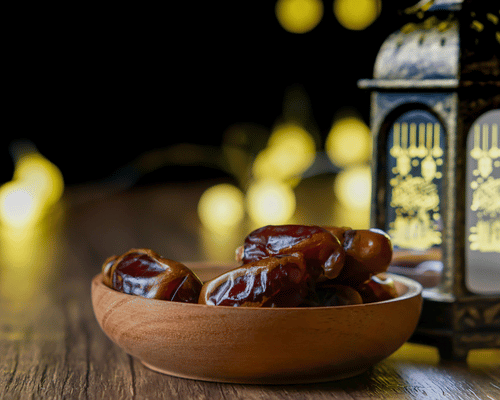
Other narrations encourage not skipping it even when there is barely anything to eat, and mention that a mouthful of water is enough to have kept the practice. Dates are specifically commended as the best suhoor for a believer.
Nobody is asking for a feast. The point is to have taken the meal.
Later Is Better
Suhoor is meant to be late, close to dawn, not eaten at midnight and slept off.
Zayd ibn Thabit described eating suhoor with the Prophet ﷺ and then going straight to the prayer. Asked how long there was between the two, he said: about as long as it takes to recite fifty verses (Sahih al-Bukhari 1921; Sahih Muslim 1097).
A short gap. Enough to finish eating and walk to the mosque.
Eating much earlier is permitted and the fast is valid, but it misses the practice. Someone who has their meal at eleven at night and sleeps until morning has eaten supper, not suhoor.
When It Ends
The Qur'an sets the limit plainly: eat and drink until the white thread of dawn becomes distinct to you from the black thread (Qur'an 2:187).
The Sunnah shows the same boundary in practice. Bilal used to give the call while it was still night, and the Prophet ﷺ told people to carry on eating and drinking until Ibn Umm Maktum gave his call - the second one, at dawn.
So the end of suhoor is the start of Fajr. Not a point before it.
The Imsak Time on British Timetables
Most Ramadan timetables printed in Britain carry an imsak time ten or fifteen minutes before Fajr, and many people treat it as the moment they must stop.
It is worth knowing what that is. The religious boundary is Fajr itself, as the verse and the narrations above make clear. The earlier time is a precaution added later, intended as a margin for safety - to stop someone eating past dawn while reaching for one more date.
Scholars differ on whether printing it is helpful. Some regard it as sensible caution. Others object that it turns a safety margin into a rule and shortens the night for no reason the texts require.
What nobody holds is that eating between imsak and Fajr breaks the fast. If you are still eating when the imsak time passes, you have not done anything wrong.
The Man Who Woke the Street
One small piece of history, now nearly gone.
Before alarm clocks, towns had a musaharati - a man who walked the streets through the night during Ramadan, drumming or calling, waking households in time for suhoor. He knew the names of the families on his round. Bilal ibn Rabah is described as the first.
The role has faded almost everywhere: people stay up later, phones have alarms, and cities are too loud and too large for a voice to carry. A few still walk in Damascus and Sidon.
It is worth remembering that getting up for this meal was, for most of Islamic history, something a street did together rather than something a person did alone.
Frequently Asked Questions
Yes. Suhoor is a strongly encouraged practice, not a condition of fasting. Someone who sleeps through it fasts a valid fast and has simply missed a sunnah and a blessing. Nobody should think their day does not count.
Stop eating and begin the fast. Some scholars cite a narration permitting someone holding a vessel when they hear the call to finish what is in their hand, but many restrict or do not apply it. The safer course is to stop. If you had already swallowed something before realising, most scholars treat an honest mistake as forgiven.
Water is enough to have kept the practice, and the narrations say so explicitly. For getting through the day, something more substantial helps - but the sunnah is fulfilled by the smallest amount.
No particular wording is established. The intention for fasting is held in the heart and does not need to be spoken. There is a widely printed Arabic formula beginning with the words for "I intend to fast tomorrow", which comes from a narration scholars have graded weak. Saying it is not wrong, but nobody needs to learn it, and nobody's fast depends on it.
You may, and the fast is valid. It is simply not the practice, which is to eat close to dawn. In a British summer, when Fajr can arrive before three in the morning, this becomes a real difficulty. Do what you can sustain across a month rather than what is ideal for one night.
Later Is Better
Suhoor is meant to be late, close to dawn, not eaten at midnight and slept off.
Zayd ibn Thabit described eating suhoor with the Prophet ﷺ and then going straight to the prayer. Asked how long there was between the two, he said: about as long as it takes to recite fifty verses (Sahih al-Bukhari 1921; Sahih Muslim 1097).
A short gap. Enough to finish eating and walk to the mosque.
Eating much earlier is permitted and the fast is valid, but it misses the practice. Someone who has their meal at eleven at night and sleeps until morning has eaten supper, not suhoor.
The Qur'an sets the limit plainly: eat and drink until the white thread of dawn becomes distinct to you from the black thread (Qur'an 2:187).
The Sunnah shows the same boundary in practice. Bilal used to give the call while it was still night, and the Prophet ﷺ told people to carry on eating and drinking until Ibn Umm Maktum gave his call - the second one, at dawn.
So the end of suhoor is the start of Fajr. Not a point before it.
Most Ramadan timetables printed in Britain carry an imsak time ten or fifteen minutes before Fajr, and many people treat it as the moment they must stop.
It is worth knowing what that is. The religious boundary is Fajr itself, as the verse and the narrations above make clear. The earlier time is a precaution added later, intended as a margin for safety - to stop someone eating past dawn while reaching for one more date.
Scholars differ on whether printing it is helpful. Some regard it as sensible caution. Others object that it turns a safety margin into a rule and shortens the night for no reason the texts require.
What nobody holds is that eating between imsak and Fajr breaks the fast. If you are still eating when the imsak time passes, you have not done anything wrong.
One small piece of history, now nearly gone.
Before alarm clocks, towns had a musaharati - a man who walked the streets through the night during Ramadan, drumming or calling, waking households in time for suhoor. He knew the names of the families on his round. Bilal ibn Rabah is described as the first.
The role has faded almost everywhere: people stay up later, phones have alarms, and cities are too loud and too large for a voice to carry. A few still walk in Damascus and Sidon.
It is worth remembering that getting up for this meal was, for most of Islamic history, something a street did together rather than something a person did alone.
Frequently Asked Questions
Yes. Suhoor is a strongly encouraged practice, not a condition of fasting. Someone who sleeps through it fasts a valid fast and has simply missed a sunnah and a blessing. Nobody should think their day does not count.
Stop eating and begin the fast. Some scholars cite a narration permitting someone holding a vessel when they hear the call to finish what is in their hand, but many restrict or do not apply it. The safer course is to stop. If you had already swallowed something before realising, most scholars treat an honest mistake as forgiven.
Water is enough to have kept the practice, and the narrations say so explicitly. For getting through the day, something more substantial helps - but the sunnah is fulfilled by the smallest amount.
No particular wording is established. The intention for fasting is held in the heart and does not need to be spoken. There is a widely printed Arabic formula beginning with the words for "I intend to fast tomorrow", which comes from a narration scholars have graded weak. Saying it is not wrong, but nobody needs to learn it, and nobody's fast depends on it.
You may, and the fast is valid. It is simply not the practice, which is to eat close to dawn. In a British summer, when Fajr can arrive before three in the morning, this becomes a real difficulty. Do what you can sustain across a month rather than what is ideal for one night.