Iftar
Iftar is the meal that breaks the fast at sunset. The word means a breaking open. It is meant to be taken promptly, traditionally with dates and water, and feeding someone else their iftar carries the same reward as fasting the day.
The meal at the other end of the day is Suhoor.
What the Word Means
The root behind iftar means to split something open - the way a seed splits, or dawn breaks.
That root has a large family, and the relations are worth seeing together. Eid al-Fitr is the festival of breaking the fast. Fitrana, which is Zakat al-Fitr, is the charity tied to that breaking. And fitrah - the natural disposition a person is born with - comes from the same place, because creation itself is described as a bringing forth by splitting open.
So a fast is not ended. It is broken, in the sense of opened.
Hasten It
Suhoor should be late. Iftar should be early. The two instructions sit exactly opposite each other, and both are about pressing up against the boundary rather than retreating from it.
The Prophet Muhammad ﷺ said that people will remain upon good as long as they hasten the breaking of the fast (Sahih al-Bukhari 1957; Sahih Muslim 1098).
Not rushing for its own sake. The point is that the fast ends when the sun goes down, and delaying beyond that - out of extra caution, or because a prayer is not finished, or because the food is not quite ready - adds something nobody asked for.
What to Break With
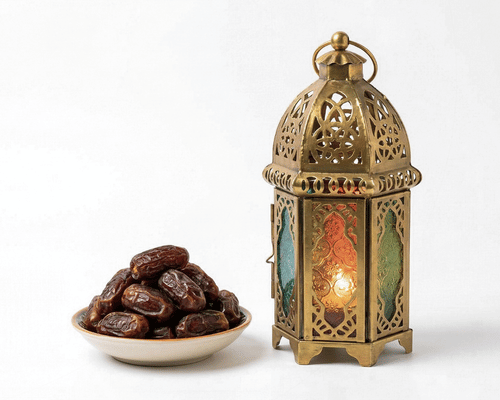
The Prophet ﷺ would break his fast with fresh dates before praying. If there were none, dried dates. If there were none of those, a few sips of water (reported in Sunan Abi Dawud and al-Tirmidhi.
A small amount, taken quickly, then the prayer, and the meal afterwards.
The order matters more than the dates do. What the practice avoids is sitting down to a full meal the moment the adhan sounds and letting Maghrib drift. Something light, then prayer, then eat properly.
The Du'a Everyone Says, and the One That Is Established
This is worth knowing, because almost every iftar in Britain gets it the wrong way round.
The established supplication is reported from Ibn Umar: Dhahaba al-zama', wabtallat al-'urooq, wa thabata al-ajru in sha Allah - the thirst has gone, the veins are moistened, and the reward is confirmed, if Allah wills (Sunan Abi Dawud 2357, graded hasan).
The one usually recited begins Allahumma laka sumtu wa 'ala rizqika aftartu - O Allah, for You I fasted, and with Your provision I break my fast. It appears in the same collection at the following number, and its chain is mursal: a link between the narrator and the Prophet ﷺ is missing. Hadith scholars have graded it weak (Sunan Abi Dawud 2358).
Its meaning is entirely good, and saying it is not wrong. But if you are going to learn one, learn the first.
There is a second thing people get backwards. The established du'a says the thirst has gone and the veins are moistened - past tense. Scholars note that it therefore fits after the first date or sip, not before. The habit of reciting it while waiting for the adhan has the sense of the words inside out.
Feeding Someone Else's Iftar
Here is the narration that explains why mosques and charities organise iftar meals at all.
The Prophet ﷺ said that whoever gives a fasting person something to break their fast with receives a reward like theirs, without the fasting person's own reward being reduced in the slightest (reported in Jami' at-Tirmidhi).
Read the second half again. Nothing is taken from anyone. The person who fasted keeps everything, and the person who provided the date receives the same - reward that is added rather than divided.
For an organisation distributing food in Ramadan, this is the text underneath the work.
One practical note. Whether Zakat specifically may pay for a cooked meal served on the premises, as opposed to a food parcel someone takes home and owns, is a question scholars have discussed. It is set out on the Tamlik page. Voluntary charity funds either without difficulty.

Frequently Asked Questions
At sunset. The adhan announces the time; it does not create it. Once the sun has set the fast is over, and waiting for the muezzin to finish is a courtesy rather than a requirement. Where a timetable and the sky disagree, scholars generally advise following a reliable local timetable.
Take something light first - a date or water - then pray, then eat properly. That is the practice, and it keeps both from being rushed. Sitting down to a full meal before Maghrib tends to push the prayer late.
No. Dates are the reported practice and carry that merit, but nothing is invalid without them. Water alone is explicitly mentioned as the fallback. Someone who breaks their fast with a glass of water and a biscuit has broken it properly.
A food parcel someone takes home is straightforward. A meal cooked and served on the premises is where scholars have differed, since the question is whether ownership transfers. The Tamlik page sets it out. If it matters to you, ask the charity which position it follows - and note that voluntary charity avoids the question entirely.
There are narrations describing the fasting person's supplication as one that is not rejected, and scholars have discussed their chains. What is agreed is that the moment is a good one for asking, and it is a shame to spend it only on the food. Whether every request is granted is not something anyone can promise, and the answer may well come in a form other than the one asked for.
The Du'a Everyone Says, and the One That Is Established
This is worth knowing, because almost every iftar in Britain gets it the wrong way round.
The established supplication is reported from Ibn Umar: Dhahaba al-zama', wabtallat al-'urooq, wa thabata al-ajru in sha Allah - the thirst has gone, the veins are moistened, and the reward is confirmed, if Allah wills (Sunan Abi Dawud 2357, graded hasan).
The one usually recited begins Allahumma laka sumtu wa 'ala rizqika aftartu - O Allah, for You I fasted, and with Your provision I break my fast. It appears in the same collection at the following number, and its chain is mursal: a link between the narrator and the Prophet ﷺ is missing. Hadith scholars have graded it weak (Sunan Abi Dawud 2358).
Its meaning is entirely good, and saying it is not wrong. But if you are going to learn one, learn the first.
There is a second thing people get backwards. The established du'a says the thirst has gone and the veins are moistened - past tense. Scholars note that it therefore fits after the first date or sip, not before. The habit of reciting it while waiting for the adhan has the sense of the words inside out.
Here is the narration that explains why mosques and charities organise iftar meals at all.
The Prophet ﷺ said that whoever gives a fasting person something to break their fast with receives a reward like theirs, without the fasting person's own reward being reduced in the slightest (reported in Jami' at-Tirmidhi).
Read the second half again. Nothing is taken from anyone. The person who fasted keeps everything, and the person who provided the date receives the same - reward that is added rather than divided.
For an organisation distributing food in Ramadan, this is the text underneath the work.
One practical note. Whether Zakat specifically may pay for a cooked meal served on the premises, as opposed to a food parcel someone takes home and owns, is a question scholars have discussed. It is set out on the Tamlik page. Voluntary charity funds either without difficulty.
Frequently Asked Questions
At sunset. The adhan announces the time; it does not create it. Once the sun has set the fast is over, and waiting for the muezzin to finish is a courtesy rather than a requirement. Where a timetable and the sky disagree, scholars generally advise following a reliable local timetable.
Take something light first - a date or water - then pray, then eat properly. That is the practice, and it keeps both from being rushed. Sitting down to a full meal before Maghrib tends to push the prayer late.
No. Dates are the reported practice and carry that merit, but nothing is invalid without them. Water alone is explicitly mentioned as the fallback. Someone who breaks their fast with a glass of water and a biscuit has broken it properly.
A food parcel someone takes home is straightforward. A meal cooked and served on the premises is where scholars have differed, since the question is whether ownership transfers. The Tamlik page sets it out. If it matters to you, ask the charity which position it follows - and note that voluntary charity avoids the question entirely.
There are narrations describing the fasting person's supplication as one that is not rejected, and scholars have discussed their chains. What is agreed is that the moment is a good one for asking, and it is a shame to spend it only on the food. Whether every request is granted is not something anyone can promise, and the answer may well come in a form other than the one asked for.